Iran War Day 102 – US Strikes Iran Again, Trump-Netanyahu Friction, Deal Diplomacy
Trump's "I call all the shots" assertion was tested the same afternoon he made it: a downed helicopter triggered new US strikes, the Strait of Hormuz remains closed after 102 days, and The American Conservative's war assessment says the president's victory framing does not match the military reality.
5 of 10 sides covered this
Not covered by Communist, Democratic Socialist, Libertarian, Evangelical
On June 9, the US launched new retaliatory strikes against Iran while the White House simultaneously projected imminent ceasefire. The framing split between outlets reading this as a live diplomatic opportunity and outlets reading it as an obscured strategic failure is the starkest ideological divide in today's digest.
How each side framed it — tap any headline for the read
Soc Con
 “The Iran War and the Future of American Empire”
The American Conservative
“The Iran War and the Future of American Empire”
The American Conservative
“tactical success, strategic failure”
frames the war as a historic overreach whose costs are being systematically undercounted. The essay treats "tactical success, strategic failure" as too charitable: Iran retained 70% of pre-war missiles, the Strait of Hormuz remains "effectively closed," 42 US military aircraft were damaged or destroyed (including an E-3 AWACS), and at least 16 US installations in eight countries suffered severe damage, some rendered "effectively unusable for military operations." [240] The first-40-days cost figure of $29 billion is "almost certainly a vast underestimate," likely double when destroyed aircraft, damaged bases, and depleted missile inventories are counted. [240] The conclusion: controlled retrenchment now or forced retrenchment later. The companion Day 102 piece reports Trump's "I call all the shots" assertion without endorsing it, noting the same-day US strikes and the FT's "friction" reporting. [232] The AmCon posture overall is restraint-realist: the war was predictably catastrophic, the triumphalism is factually false.
Read the original ›
MAGA
 “Trump keeps forecasting an Iran deal...”
Fox News
“Trump keeps forecasting an Iran deal...”
Fox News
“final throes.”
frames the same situation as evidence of Trump's deal-making leverage. The story centers White House confidence, Trump's optimism, and the administration's assertion that nuclear negotiations are in their "final throes." [351] Iran's missile retention, the Hormuz closure, and the mounting cost figures do not appear. The war is a negotiating context Trump controls.
Read the original ›
Liberal
 “U.S. and Iran Zero In on Four Nuclear Issues in Talks”
NYT
“U.S. and Iran Zero In on Four Nuclear Issues in Talks”
NYT
treats the diplomacy as the primary story, reporting on specific nuclear issues under negotiation without evaluating the military context. [150]
Read the original ›
Center
 “Shippers Wary of Red Sea Routes Despite Houthi Pledge”
WSJ
“Shippers Wary of Red Sea Routes Despite Houthi Pledge”
WSJ
covers the economic aftereffect -- shipping companies declining to resume Red Sea routes despite Houthi pledges -- without framing it as evidence of strategic failure. [220]
Read the original ›
Identity
 “What Iran and Israel's latest exchange of fire is really about...”
Mondoweiss
“What Iran and Israel's latest exchange of fire is really about...”
Mondoweiss
“a united axis of resistance to U.S.-Israeli hegemony in the region.”
frames the June 8 exchange as Iran reasserting "a united axis of resistance to U.S.-Israeli hegemony in the region." [534] Iranian escalation is read as a long-term strategic move to reconstitute the resistance axis; US-Israeli military action is framed as an ongoing project of regional hegemony. The analysis inverts the Fox framing: the party under strategic pressure is the US, not Iran.
The AmCon-Mondoweiss convergence is the most striking alignment today: two publications that share almost no readers, premises, or politics both concluded the war is failing on its own terms. AmCon frames the failure as imperial overstretch; Mondoweiss frames it as the logical result of attempting to suppress an axis of resistance. All covered sources today shared one significant omission: no outlet asked whether Congress has authorized this war, what its termination conditions are, or what "winning" now means given that the original objectives (regime change, nuclear program elimination, missile destruction) have not been met.
Read the original ›
The facts — what the record establishes
On June 9, Day 102 of the US-Israel war on Iran, an Army Apache helicopter was downed near the Strait of Hormuz. US forces launched retaliatory strikes against Iran at 5 p.m. ET "in response to yesterday's downing," with the Pentagon calling it "a proportional response to unjustified Iranian aggression." [173][232] Israeli strikes continued in Lebanon, killing at least 29 people in 24 hours and at least eight in and around Tyre after forced displacement orders were issued. [232] Iran's Tasnim News Agency stated the halt in hostilities is "conditional" and warned of "an even more crushing response" to further Israeli aggression; Iran described the situation as "a new equation" extending its deterrence to Lebanon. [232] Trump told FT: "I call the shots. I call all the shots. [Netanyahu] doesn't call the shots," adding that Netanyahu "won't have a choice" but to accept a deal. Secretary Rubio "played a significant role" in getting Trump to back Israeli retaliatory strikes, according to Israel Hayom. [232] An independent journalist reported that elements of an 82nd Airborne battalion were quietly deployed to Israel in April, tied to joint contingency planning for capturing Iran's Kharg Island. [232] Brent crude was above $91/barrel; national average regular gas was $4.16. [232]
The takeaway
AmCon and Mondoweiss treated this as a failure in progress; Fox treated it as a diplomatic opportunity in Trump's hands; NYT and WSJ treated it as an ongoing management problem for institutions to navigate. The category split is: strategic catastrophe vs. deal-making leverage vs. institutional process story. The most significant collective blind spot is the authorization question: no covered source today named the war's legal basis, its termination conditions, or measured Trump's deal optimism against the specific military data in AmCon's assessment. [240][351]
---
House Passes $70B DHS/ICE Bill – 115-Day Standoff Ends Without Reforms
Democrats spent 115 days demanding body cameras, judicial warrants, and no masked officers; they received none of it, and ICE is now funded at more than 3x its annual budget through 2029 with almost no accountability strings.
2 of 10 sides covered this
Not covered by Communist, Democratic Socialist, Social Conservative, Libertarian, MAGA, Evangelical, Tech
The $70 billion bill ended a 115-day standoff, and both Liberal outlets covered it as a Democratic rout -- but their framing of what that means diverges.
How each side framed it — tap any headline for the read
Liberal
 “House passes bill to fund ICE and Border Patrol...”
NPR
“House passes bill to fund ICE and Border Patrol...”
NPR
“circumvent”
frames the outcome as a governance failure with institutional consequences. Democrats sought reforms and got none; Republicans used reconciliation to "circumvent" Democratic leverage; Congress has "ceded its ability to provide oversight" for three years by appropriating a multi-year lump sum with almost no spending stipulations. [140] NPR lists the stripped reforms specifically and sources concern to former agency leaders across parties. The frame is procedural anxiety: the checks-and-balances architecture failed.
Read the original ›
Liberal
 “Republican-led House narrowly passes Trump's $70bn bill...”
The Guardian
“Republican-led House narrowly passes Trump's $70bn bill...”
The Guardian
“mass deportation campaign.”
frames the same vote as a direct product of Trump's "mass deportation campaign." [173] The Guardian's live coverage labels the reconciliation process a mechanism for institutionalizing the deportation agenda; Tim Walberg's vote change after being surrounded by Republican leaders is reported as a vivid illustration of party discipline. The Guardian adds the same-day US strikes on Iran to its live blog, framing both as parallel expressions of executive power consolidation.
Neither covered source today examined what broke Democrats' calculus after 115 days of holding firm -- reconciliation bypassed their leverage entirely, but no outlet asked whether Democrats had a strategy for that contingency. The Minneapolis shooting that triggered the standoff appears in NPR's coverage as a subordinate clause. No covered source today treated the Minneapolis accountability question as still open.
Read the original ›
Center
“PBS, Politico (multiple articles)”
The facts — what the record establishes
The House voted 214-212 on June 9 to pass a $70 billion reconciliation bill funding DHS, specifically ICE and Border Patrol, through fiscal year 2029. The vote was briefly tied at 213-213 when Rep. Tim Walberg (R-MI) voted No; he changed his vote after being "surrounded by House Republican leaders," and the measure passed. [173] The bill allocates $38 billion for ICE, $22 billion for Border Patrol, $5 billion for border security technology including AI, and $350 million for enforcement in non-cooperative localities. [140] ICE's usual annual budget is approximately $10 billion; a $75 billion boost last summer had already made it the highest-funded federal law enforcement agency. [140] The standoff lasted 115 days following the shooting death of two protesters by federal officers in Minneapolis. [140] Sen. Lisa Murkowski was the only Republican to vote against the bill in the Senate. The measure strips out all reforms Democrats demanded: no judicial warrants for home entry, no prohibition on masked officers, no body cameras, and no internal oversight funding. [140]
The takeaway
Liberal and Center coverage treated this as a Democratic legislative defeat; the framing split is between NPR's procedural concern (oversight erosion) and the Guardian's power-politics reading (mass deportation institutionalized). The most significant shared omission: neither outlet interrogated what changed, examined Democrats' contingency strategy, or returned to the Minneapolis shooting as an unresolved accountability question that the bill may now permanently bury. [140][173]
---
Maine Democratic Senate Primary – Graham Platner
The Democratic establishment's preferred framing and the insurgent's preferred framing are unresolvable from today's coverage, and that ambiguity is itself the story: tonight's result will either validate the sabotage thesis or the character-disqualification thesis, but cannot validate both.
5 of 10 sides covered this
Not covered by Communist, Liberal Mainstream, Libertarian, Evangelical
The Maine primary today generated the sharpest framing divergence in the digest. The factual record contains two internally consistent stories, and today's coverage splits cleanly along which story each outlet chose.
How each side framed it — tap any headline for the read
Dem Soc
 “Did the Democrats Sabotage Graham Platner?”
Truthdig
“Did the Democrats Sabotage Graham Platner?”
Truthdig
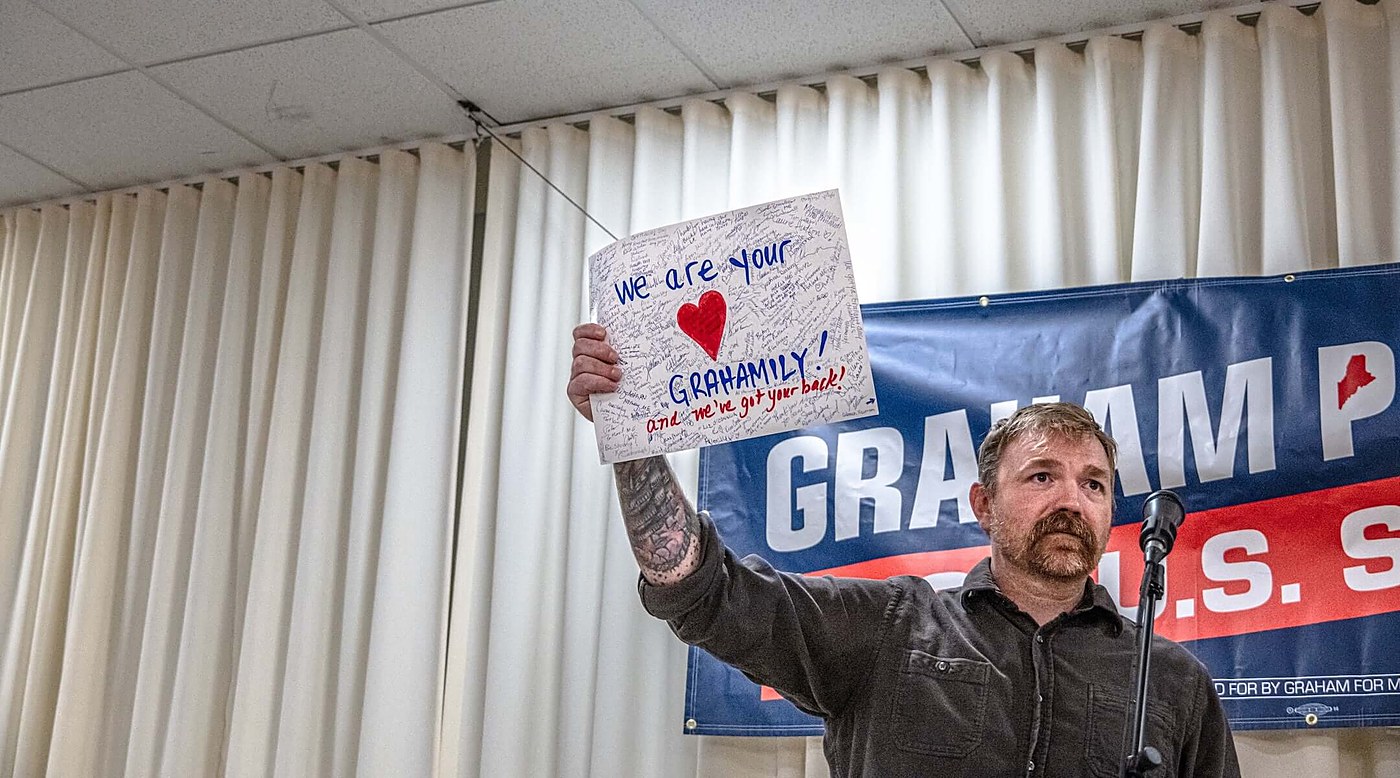
frames Platner's troubles as a coordinated removal operation. The argument: "an inconvenient insurgent, internal material weaponized by his own side, a Republican-linked source and a calendar tuned to a removal-and-replace statute." [106] Truthdig treats the Democratic establishment as the primary actor and the allegations as instrumentalized rather than evaluated on their merits.
Read the original ›
Soc Con
 “The Mendacity of Graham Platner”
National Review
“The Mendacity of Graham Platner”
National Review
makes the opposite move: the man's record of misrepresentation is the disqualifying fact, independent of who publicized it or when. [225] Character is the frame; the insurgent-vs.-establishment dynamic is analytically irrelevant.
Read the original ›
MAGA
“Maine Democrats decide fate of Senate candidate dogged by explosive allegations”
Fox News
treats the primary as a measure of Democratic voters' judgment and centers the explosive allegations themselves as the substance of the story. [357] Fox's interest is in the drama, not the structural analysis.
Read the original ›
Center
 “Some Maine Democrats are wavering...”
Politico
“Some Maine Democrats are wavering...”
Politico
“maintains a strong base of support”
reports voter wavering without resolving the underlying question: Platner "maintains a strong base of support" but the scandals have left "a bad taste." [210] The Politico piece brackets both the sabotage claim and the allegation substance, treating the race as a horse-race with uncertain outcome.
Read the original ›
Identity
 “Israel looms large...”
The Forward
“Israel looms large...”
The Forward
focuses on Platner's AIPAC rhetoric as a primary story about Jewish communal politics, quoting Jewish organizations' antisemitism concerns while noting that some defenders linked negative press coverage to his Israel positions. [582] The Forward frames Israel as a live electoral fault line in Maine Democratic politics, a dimension the Center outlets largely omitted.
Fox and National Review converge on character disqualification despite incompatible analytical frameworks: Fox's approach is drama-centered, NatRev's is argument-based, but both concluded the man should not win. The sabotage thesis (Truthdig) and the character thesis (NatRev) cannot both be true in the same form, and tonight's result will generate a new round of incompatible interpretations regardless of outcome.
Read the original ›
The facts — what the record establishes
Graham Platner, 41, an oysterman and political newcomer, is running in today's Maine Democratic primary to challenge incumbent Republican Sen. Susan Collins. His campaign faces allegations: a tattoo accused of resembling a Nazi symbol that he says he didn't recognize until late 2025; accusations of sending sexually explicit texts to women he met online; an ex-girlfriend alleging physical altercations including being "grabbed by the shoulders." [210][582] In the campaign's final days, he accused Collins of being "bought and paid for by Benjamin Netanyahu" and stated in his first online ad that he would never receive AIPAC's endorsement because Israel had committed genocide in Gaza. [582] Multiple Jewish groups called the AIPAC framing antisemitic. [582] Truthdig argues the timing of the allegations' publication follows a pattern of establishment sabotage, with material originating from "a Republican-linked source" timed to the removal statute. [106] Primary results are expected tonight.
The takeaway
Truthdig treated this as an establishment operation; NatRev and Fox treated it as a character judgment; Politico treated it as a wavering horse-race; The Forward treated it as an Israel-politics inflection point. The category split is: insurgent-vs.-machine vs. fitness-for-office vs. Israel proxy battle. The shared blind spot across all covered outlets: no source verified the "Republican-linked source" claim Truthdig makes, examined whether the specific allegations have been independently corroborated, or reported what the removal-and-replace statute's concrete timeline is if Platner wins tonight.
---
LA Mayor Race – Democratic Socialist Nithya Raman Advances to Runoff
Nithya Raman's advance is being told as a democratic socialist electoral victory; what neither outlet examined is what a Raman-Bass general election actually means for Los Angeles governance after the fires.
2 of 10 sides covered this
Not covered by Communist
Two outlets covered the same result with irreconcilable factual emphasis.
How each side framed it — tap any headline for the read
Dem Soc
 “Democratic Socialist Overcomes GOP-Funded Opponent...”
The Intercept
“Democratic Socialist Overcomes GOP-Funded Opponent...”
The Intercept
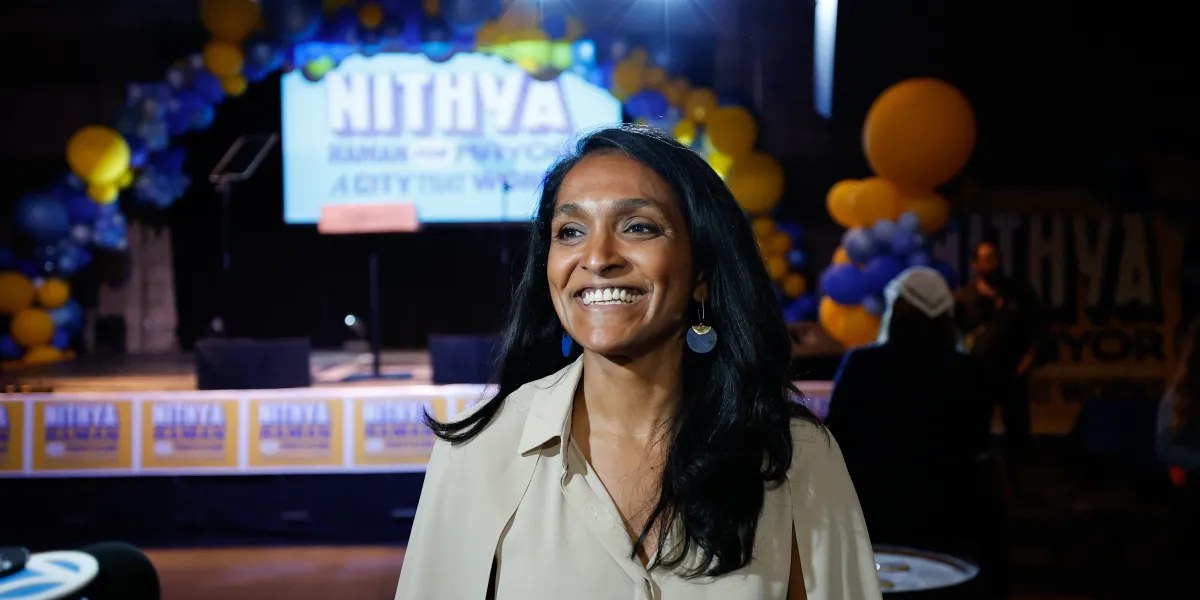
foregrounds Raman's DSA affiliation and the Republican funding behind Pratt, constructing the race as a proxy contest between organized democratic left politics and GOP interference in a Democratic primary. [82] The narrative is structural: the grassroots democratic socialist beat the money.
Read the original ›
Center
 “Progressive Nithya Raman advances...”
PBS
“Progressive Nithya Raman advances...”
PBS
“progressive”
describes Raman as a "progressive" without mentioning the DSA, and frames the Raman-Bass matchup as a contest between two established figures with policy disagreements, with Bass under scrutiny for fire management. [200] PBS's companion Pratt piece treats his campaign as a celebrity narrative rather than a GOP funding story. [203] The Intercept and PBS read the same result as different categories of event: ideological proxy battle vs. normal electoral process.
Read the original ›
The facts — what the record establishes
LA City Councilmember Nithya Raman advanced to a November runoff against incumbent Mayor Karen Bass after defeating Spencer Pratt, a reality TV personality who ran on a homelessness platform. [82][200] The Intercept describes Raman as a member of the Democratic Socialists of America; she received GOP funding from Pratt's campaign opponent. [82] PBS describes Raman as a "progressive." [200] The November runoff will be Raman vs. Bass.
The takeaway
The category split is: democratic socialist electoral breakthrough vs. standard primary between two legitimate candidates. The shared omission: neither outlet asked what a Raman mayoralty would mean for LA's post-fire reconstruction, its relationship with state and federal government under the current administration, or whether Bass's vulnerabilities are primarily about the fires or about a broader progressive-vs.-establishment dynamic playing out simultaneously in Maine.
---
Apple WWDC 2026 – iOS 27, Siri AI, and the EU Standoff
Apple rebuilt Siri on Google Gemini and confirmed the EU will not receive it at launch; the tech press covered the feature list, and only The Verge asked what Apple is actually doing to EU regulators.
Within Tech / AIthe internal split · 3 standpoints
Three Tech/AI outlets covered the same WWDC announcement but sorted on different axes of the internal optimist-to-critical spectrum.
The standpoints — tap any headline for the read
announcement
 how they framed it
TechCrunch, Wired
how they framed it
TechCrunch, Wired
covers WWDC as a product story: what was announced, what changed, what ships. [763][792] The register is enumeration. Neither piece evaluates whether the Google Gemini underpinning of Siri creates privacy implications, or what Apple's documented privacy commitments mean when on-screen user data flows through a Google model.
EU-critical
 “Apple wants Europe to blink”
The Verge
“Apple wants Europe to blink”
The Verge
frames the EU non-availability as a negotiating tactic rather than a compliance technicality. [785] Apple is withholding a major product update to pressure EU regulators over Digital Markets Act requirements. The framing is: this is power politics, not technical delay.
The internal Tech/AI split here is features-optimist (TechCrunch/Wired) vs. platform-power-skeptical (The Verge). What no covered outlet examined: the implications of Google Gemini powering Siri for Apple's longstanding privacy positioning, or the antitrust relevance given the DOJ's ongoing scrutiny of the Google-Apple search deal.
Read the original ›
The facts — what the record establishes
Apple held its WWDC 2026 keynote, announcing iOS 27, iPadOS 27, macOS 27, and a rebuilt version of Siri described as running on Google Gemini as part of "Apple Intelligence." [763][792] The new Siri offers cross-app context awareness (Messages, Mail, Photos, and on-screen content) without switching apps. Apple Intelligence features include tab management for Safari, one-tap password updating, and AI-powered reply suggestions in Messages. [763] Apple confirmed that the new Siri AI will not be available in the EU on iOS 27 at launch, citing the Digital Markets Act. [785]
The takeaway
TechCrunch and Wired treated WWDC as a consumer feature story; The Verge treated it as a regulatory power move. The category split within Tech/AI is: product announcement vs. platform-politics story. The most significant shared omission: no outlet asked why Apple chose Google Gemini specifically over its own models or other providers, or what that choice means for the privacy commitments Apple has used as a market differentiator for a decade.
---
Is AI Slowing? – The Internal Tech/AI Debate
Gary Marcus and Ed Zitron both published today on the same METR capability graph and reached opposite conclusions; Palladium published a theological framework for why the empirical debate keeps failing to resolve.
Within Tech / AIthe internal split · 5 standpoints
The METR graph served as a Rorschach test today for the Tech/AI lens's internal fault lines.
The standpoints — tap any headline for the read
hype-critical
 “AI Is Slowing Down”
Ed Zitron
“AI Is Slowing Down”
Ed Zitron
treats the graph as confirmation that diminishing returns have arrived and that the financial case for continued AI investment has collapsed. [646] Zitron's argument is empirical-economic: marginal utility of new models is declining, enterprise adoption is below projections.
Read the original ›
safety-skeptic
 “Misplaced panic over AI progress”
Gary Marcus
“Misplaced panic over AI progress”
Gary Marcus
“misplaced panic”
makes a methodological argument: the METR data shows task-specific extrapolation, not general capability curves, and "misplaced panic" is as epistemically wrong as misplaced optimism. [700] Marcus occupies a distinctive position: he is skeptical of both the optimist and the pessimist readings, insisting neither is warranted by the available data.
Read the original ›
theological
 “The Rival Theologies of Artificial Intelligence”
Palladium
“The Rival Theologies of Artificial Intelligence”
Palladium
steps outside the empirical dispute entirely, arguing that the optimist-pessimist split cannot be resolved by evidence because it is fundamentally a dispute about human destiny. [721] Palladium's framing makes both Zitron and Marcus adjacent positions in a prior theological argument.
Read the original ›
optimist
 “Roundup #83: I told you so!”
Noahpinion
“Roundup #83: I told you so!”
Noahpinion
“misplaced panic”
treats today as a vindication moment for prior predictions. [701]
Marcus and Zitron share a rejection of naive AI hype but reach opposite conclusions from the same data: Marcus calls the plateau "misplaced panic"; Zitron calls it confirmation of a wall. Neither engaged the other's piece today.
Read the original ›
The facts — what the record establishes
METR, a safety-focused AI evaluation organization, released a graph of AI capability growth on software engineering tasks appearing to show a plateau in recent progress. [700] Ed Zitron published a long analysis arguing AI development has hit a wall of diminishing returns and that the plateau confirms his ongoing thesis about AI hype and bubble dynamics. [646] Gary Marcus published a rebuttal arguing the "panic" is "misplaced" because the METR graph shows current-task extrapolation, not general intelligence trends, and that the Y-axis scaling creates an illusion of plateau. [700] Noah Smith published a vindication roundup. [701] Palladium published a long-form essay framing the AI optimist-pessimist debate as two incompatible "theologies" that cannot be resolved by data. [721] Slow Boring argued that nobody has the conceptual tools to evaluate AI consciousness claims. [740]
The takeaway
The Tech/AI internal axis today runs: empirical-pessimist (Zitron), methodological-skeptic (Marcus), vindicated-optimist (Noahpinion), and theological-framework (Palladium). The category split is: bubble confirmation vs. methodological caution vs. a theological dispute about human-technology destiny. The Palladium piece is analytically the most interesting because it names why the empirical debate keeps failing to resolve: each camp uses the same data to confirm a prior commitment. What no piece in this cluster addressed: the Apple WWDC announcement that Google Gemini is now embedded in Siri for approximately 1.5 billion active devices, which makes the abstract capability debate about deployment reality rather than future possibility.
---
Lockheed Martin and RTX (Raytheon) hold primary US contracts for THAAD and Patriot interceptors; the Pentagon expanded those contracts in January 2026 with Patriot production increasing from 600 to 2,000 annually and THAAD from 96 to 400. The Iran war consumed more than 90 THAAD interceptors, roughly 14% of total US inventory, creating direct demand for the accelerated production schedule (
Time). The American Conservative's assessment that the war has depleted US missile inventories is simultaneously a readiness crisis and a contractor revenue driver.
[240]
AIPAC and the NDAA Section 224 pipeline: AIPAC lobbied in Q1 2026 for the US-Israel FUTURES Act at DoD and on Capitol Hill; all four congressional sponsors received substantial AIPAC campaign contributions (
OpenSecrets). The FUTURES Act died as standalone legislation; a nearly identical provision (Section 224) was inserted into the NDAA. Rep. Thomas Massie, who opposed it and all foreign military aid, lost his primary to a Trump-backed challenger after AIPAC spent against him. The current US-Israel MOU, providing $3.8 billion annually and expiring in 2028, is the financial relationship Section 224 would replace with permanent tech integration.
[83]
ICE technology contractors: The $70 billion bill includes $5 billion specifically for "border security technology and screening, including artificial intelligence," with no accountability mechanism specifying how or when it must be spent.
[140] The specific contractors positioned to receive those technology contracts are not identified in any coverage today. The bill explicitly excludes internal oversight offices that could monitor the spending.
The Strait of Hormuz closure and energy markets: The Strait, through which 20% of world oil and LNG flowed before the war, remains effectively closed.
[240] Brent crude was above $91/barrel and national average gas was $4.16.
[232] WSJ reports shipping companies remain wary of Red Sea routes despite Houthi pledges, suggesting the economic disruption is durable.
[220] The households absorbing $4.16 gas are not named as a stakeholder in any political-ideological outlet today; the oil and shipping companies whose contract structures have adjusted to the closure are also not addressed.